





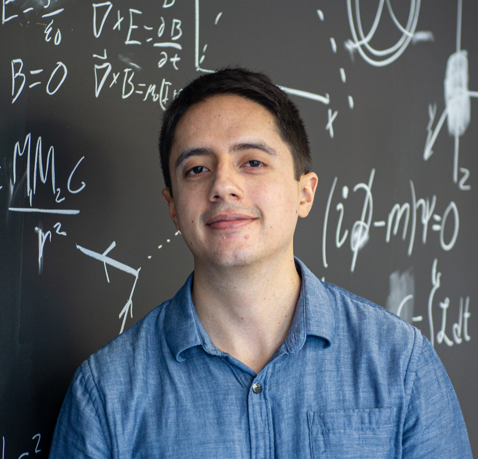



Samuel Audet
PhD student
Université de Montréal
Samuel Audet is a doctoral student in physics at the University of Montreal. He completed a master’s degree there under the supervision of Arthur Lalonde, where his work focused on the Monte Carlo modeling of an ultra-high dose rate FLASH radiotherapy device. He then worked as a medical physicist at the Rouyn-Noranda Regional Radiation Oncology Centre between 2024 and 2025, contributing to clinical radiotherapy activities. He is currently pursuing his doctoral studies at the University of Montreal, where his research focuses on accelerating treatment plans in volume-modulated radiation therapy (VMAT) within the context of adaptive radiotherapy (ART). His research aims to integrate artificial intelligence approaches to optimize and improve the efficiency of radiotherapy planning processes.
Publication
Phys. Med. Biol. 70, 2025, 085002
Abstract:
FLASH radiotherapy (FLASH-RT) is an emerging treatment modality that delivers ultra-high dose rates (UHDR) to achieve effective tumor control while minimizing damage to healthy tissues—a phenomenon known as the FLASH effect. Accurate modeling of the electron energy spectrum is essential for UHDR linacs used in FLASH-RT to ensure reliable dose calculations and effective treatment planning. This study introduces a novel, physics-based method to reconstruct electron energy spectra specifically tailored for compact UHDR linacs lacking bending magnets, which present unique challenges for beam modeling. A physics-based energy spectrum optimization (PESO) algorithm was developed to model electron beam dynamics within a compact linac with minimal free parameters. The PESO approach was evaluated against two conventional methods—simulated annealing (SA) and Gaussian regression (GR)—using radiochromic film measurements in solid water phantoms for three applicator sizes (25 mm, 40 mm, and 60 mm) in both conventional and FLASH modes. Accuracy of the reconstructed isodoses and robustness against measurement errors was evaluated for each method. We successfully implemented the PESO algorithm to resolve the electron beam dynamics as a function of the electric field within the waveguide. The method constrained the solution to physically plausible spectra and achieved superior dosimetric accuracy compared to both GR and SA for the 6 MeV UHDR beam, while producing results comparable to SA (and better than GR) for the 9 MeV UHDR beam. PESO also demonstrated reduced sensitivity to measurement errors and maintained consistency, even for the low-energy tail components of UHDR electron beams. By incorporating physically based constraints into the beam modeling process, PESO offers improvements in the reliability and precision of electron energy spectrum reconstruction for UHDR linacs. This development addresses challenges in electron FLASH-RT dose calculation and may aid in the clinical implementation of FLASH radiotherapy.